

4 Steps to Align
Pillar One: Intuition

The book I’ve been writing seems to be in a period of gestation, asking to be something different so I’m trying to give it the time and space to tell me what it is. So for the better part of 2025, I was in stealth mode building a workbook that encapsulates the themes and premise of my original book. The workbook uses many of the questions I asked and steps I took when I shuddered my startup. At a time when I was the most unclear and confused about the direction of my life, when I realized I had to relinquish societal timelines, other people’s definition of success, and build a life that reflected my core values which felt harder and harder to do in a late stage capitalist environment.
I asked myself, “What would it mean to to live boldly, authentically, and on my own terms?” If "too much" wasn't something to shrink from rather something to step into?” I wanted to live a life that felt fully mine.
Reading essays and listening to podcast episodes is one thing and practical integration is another. So I created The Too Much Workbook, 40 pages of exercises designed to help you get clear on your purpose, identify where your energy thrives (and where it drains) , manifest a life that's in congruence with who you really are and build your own blueprint instead of following someone else's. It’s extremely approachable and a first step to building a life in alignment. Think of it as a primer. It will be launching on April 20th. The first 25 buyers will be invited to a zoom workshop where we dive into the workbook together. And if you have any questions, just reply to this email. I read every single one. This work we're doing together, it matters. I receive comments, emails and texts every week that reminds me of that and I’m so deeply grateful to all of you for being a part of my corner of the world. Thank you for being here. Thank you for trusting me with your time and attention.
A couple testimonials from early readers:
“My favorite section was the What is Your Why. Love that it’s a mix of reflection/aspiration/action in a tangible way.” - Kate
“This book is like a mirror, are you ignoring your own reflection? This workbook is about learning how to unblock oneself from being fulfilled.” - Jess
My therapist has a lot of mic drops. Too many to even remember but there are a couple phrases that have become wisdom I repeat to others much like Oprah’s isms “When you know better, you do better” and “What I know for sure.” One of them is “Life is a process of getting back to alignment.” Alignment has been the core metric of my life post startup. When we are in congruence with our core truths, life magnetizes to you. Now, the nature of life will naturally veer us off course so we need to understand what alignment feels like to know when we have inevitably fallen out of it.
Ok Denise, we understand this works for you but I don’t even know what alignment is.
Fear not, dear reader. I got you! How do I define alignment?
Alignment is essentially inner peace. You’re living in your purpose and values, you find ease in the every day, you’re not betraying yourself to work, live, or exist. When you’re in that state, life has a way of unfolding.
I have a 4 step formula I created that has helped me arrive back at this space I covet so dearly. I am going to break this into a 4 part series. Our first pillar on the path to alignment is Intuition.
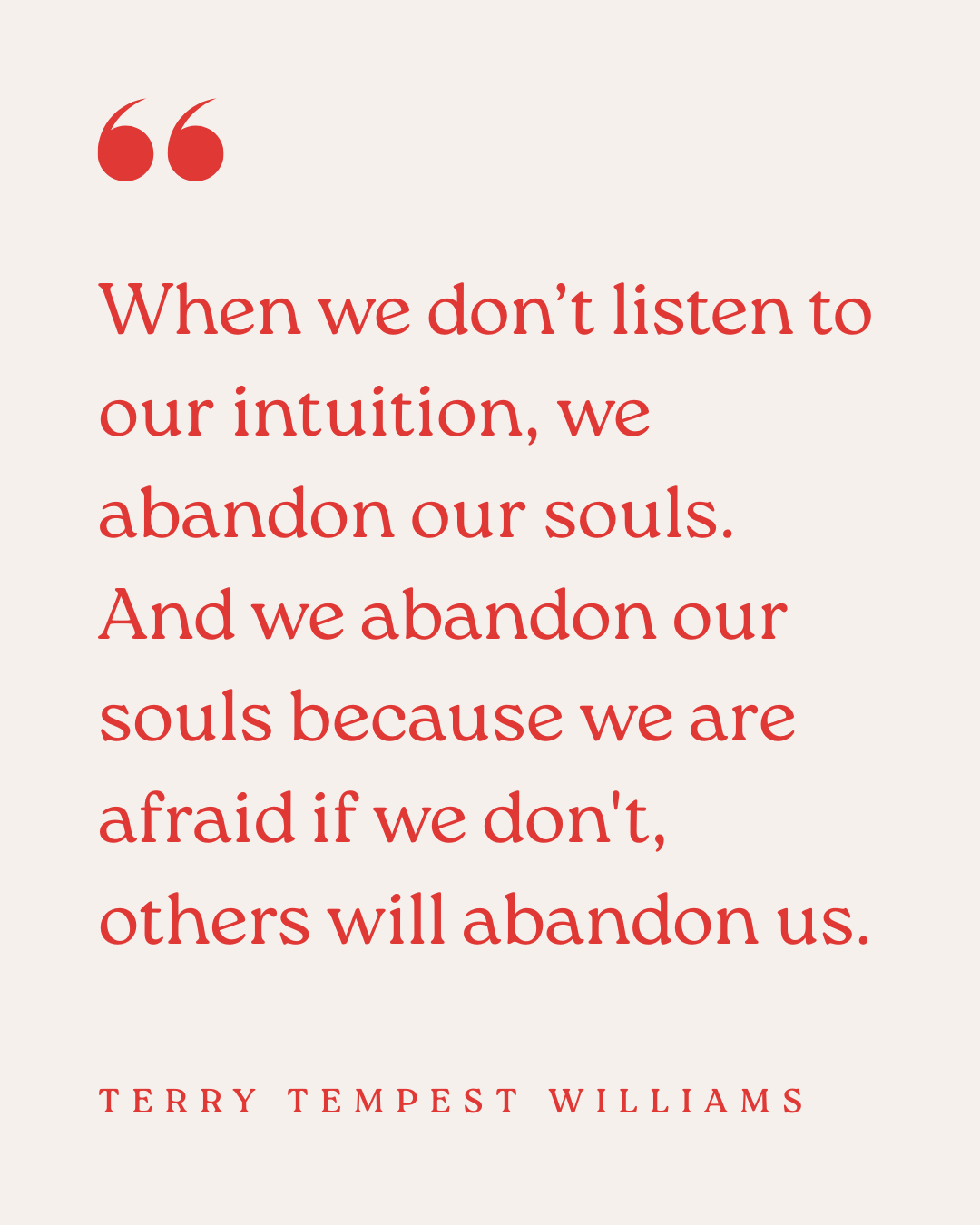
You might think that one of the greatest logical thinkers of all time would find no value in the intuitive mind, but on the contrary, Albert Einstein described it as a sacred gift and the rational mind as a faithful servant. He believed it paradoxical that in the context of modern life, we began to worship the servant and defile the divine. Napoleon described his intuition as his ‘star,’ for Socrates and Goethe it was their daemon, a negative inner voice that protected them by showing them what to avoid. You may think of it as your muse, or a spirit moving through you. Intuition may be life’s great secret. We think of people like Einstein, Napoleon, and Goethe as geniuses, that they have something we do not. Perhaps what truly separates us from the greats, from unlocking our own divine genius, is our failure to develop our intuition.
The definition of intuition according to the Oxford Language Dictionary is “the ability to understand something immediately, without the need for conscious reasoning…a thing that one knows or considers likely from instinctive feeling rather than conscious reasoning.” This definition doesn’t quite do the concept justice. Our inner voice is one of humanity’s most important superpowers, one every one of us possesses, yet many of us don’t know how to access.
It is impossible to truly know ourselves if we resist cultivating it…and knowing ourselves is the essential first step toward alignment. If we can’t hear ourselves, how do we expect to hear anybody else? If we don’t know ourselves, how do we expect to know our employees or our clients? Intuition is our best internal compass for our own personal life map. Being an authentic person is about being wholly yourself so if we follow society’s map versus our own soul map, we will never access our greatest timeline. And that’s what we’re really here to do right?!
But in the world we live in, it’s easy to ignore our intuition. We don’t trust it easily because it’s a silent, unquantifiable wisdom. We prioritize “rational thinking” instead. Because of society’s emphasis on the rational, most of us disconnect from this valuable function within us. We are not conditioned to develop it as the essential human skillset that it is. For women, we may disconnect from our intuition because our emotions are gaslit by culture. We’re told that we’re too emotional, that we’re too this or too that. The erosion of the commentary on our bodies, minds and appearance cuts us off from our inherent knowledge and we may start to second guess our feelings and ultimately, ourselves. Men, too, experience a disconnect from intuition as they’re told to ignore their emotions. They repress them so they are no longer connected to their body. This leaves them unaware of an inner voice. I can’t speak to the nuance of non-binary experiences and I know these are general descriptions but I’m placing these here to give us a baseline of understanding on why intuition is undervalued.
70% of adults have experienced a traumatic event at least once in their lives. Renowned trauma researcher (whose work has recently come under scrutiny), Bessel van der Kolk believes that traumatized people often become experts at ignoring their gut feelings because they feel unsafe in their bodies. That’s a lot of people disconnected from their internal intelligence system. This disconnection causes ripple effects of chaos in our lives. When we actually connect to ourselves, we can follow the path that is meant for only us instead of being derailed by the path that trauma carves.
It’s hard to discern what is our voice when trauma is running the show. Many of us confuse our anxiety or trauma responses for intuition. When what’s happening to us/around us isn’t validated we are taught that our feelings aren’t valid and then we subsequently learn to stop trusting ourselves. When that persists, we disconnect from ourselves. Though, the voice of anxiety or trauma is different, usually a louder one that if we tune in, lives in our head. Laura Matsue, a psychospiritual coach and astrologer thinks of it as having more urgency and finds it’s fear based. It usually screams in the absence of real danger. Our intuitive voice is quieter, it’s nuanced, which is why slowing down and finding some presence can help us locate it. It often lives below our heads somewhere in our body.
Surprisingly or maybe unsurprisingly, there is evidence that intuition exists and is quantifiable despite intuition being perceived as unquantifiable. In 2016, at the University of New South Wales, researchers Galang Lufityanto and Chris Donkin conducted a study “to prove the existence of intuition,” which they defined as “the ability to make successful decisions without rational, analytical thought or inference”. They pioneered a way to measure this information scientifically. They had the subjects determine the direction a dot was moving on a computer screen while viewing a series of images with different charges (positive or negative). They used a ‘technique known as continuous flash suppression, in which images don’t register consciously. The subjects did not know they were seeing the series of images but their eyes registered them while the brain reacted to them. Would the brain then rely on these images to help determine which direction the dots were moving? Was there a correlation? In fact, there was. In the same way, our brain scans a new place to determine safety or quality, this study helped to define how the brain works in situations where we have little information. Intuition is a proven inference tool of the brain to guide us when we don’t have all of the information.
Friederike Fabritius and Hans Hagemann, authors of, The Leading Brain : Neuroscience Hacks to Work Smarter, Better and Happier, agree. "Although there's a common misconception that intuitive decisions are random and signify a lack of skill, the exact opposite is true. Intuitive decisions are often the product of years of experience and thousands of hours of practice. They represent the most efficient use of your accumulated experience." Intuition is actually a brain device that aids humans in great decision making. Which is why, the sooner we can trust this intelligence, the better off we will be.
In my early career, I didn’t recognize my body’s clear response to situations as an intelligence. I would just move on instinct. Over time, as I realized how those feelings had guided me, I started to listen more intently to my body. When we move into awareness around that instinct, we can recognize how it speaks to us in support of our highest good, this becomes intuition. There is nuance between instinct and intuition. I honed my instincts into intuition. Intuition is the conscious definition of instinct. By embracing the response, I have refined my intuitive sense. I am often surprised by how exact it has become.
I know this is all a little academic and heady but I feel it is imperative to bring the science and history in to ground us in the concept. But you know me, I like to look at the spectrum of it all which is why I needed to delve into the more emotive side of intuition. I found the mother of intuition, Anabel Zenith, a Berlin based spiritual guide who describes herself as a witch, a term she uses purposefully because it’s intrinsically political. Anabel’s approach combines liberation psychology with esoteric traditions. Under the umbrella of guide, one of her spokes is an Intuition Course, aptly named “Intuition is Your Birthright.” She believes intuition is the seed and starting point of all spiritual work.
For her, intuition is a quiet rebellion. In a society that often conditions us to disconnect from ourselves, trusting our intuition becomes a revolutionary act. She poses a thought-provoking question: If trust is the foundation of every relationship, including the one with ourselves, how does it manifest? How do we see it? With ourselves, it’s how we love ourselves, how we show up for ourselves. The ultimate manifestation of deep self-love is cultivating our intuition. When we engage with intuition and trust that it is real, we are in a relationship of reciprocal love with ourselves. To feel something in our body and not push it away opens up so much more space for compassion, releases judgement, and strengthens deep self-belief. Becoming self-sourced is a radical space to inhabit because no one can take away your self-concept. This is why intuition is so indisputably powerful in a culture that conditions us to disconnect from self.
Low-key obsessed and blown away by Anabel’s take on intuition, I had the luxury of going a little deeper and experiencing one of her exercises she uses in her course called truth vs. a lie. She starts by taking her students through a deep meditation to get them to a place of receptivity, connectedness and association. Once they’ve arrived she has them recite their birthday mentally, noting where they feel this truth in their body. Different people feel their intuition in different places, so she doesn’t tell them where to locate it but rather lets it speak directly to each individual. This is followed by reciting a false birthday, again observing the bodily sensations. Then she has her students verbalize each birthday, one true and one false, noticing if the feeling changes. She wants them to observe if this truth is coming from somewhere else in the body now that it’s being spoken out loud. She proceeds with more and more questions so the pupil can get a strong sense of themselves, what is true for them, their intuitive voice and where they locate it in their body.
In my experience, I discovered that I felt the false birthdays in my head. They pinged around my skull each time I thought or spoke them aloud. My intuitive voice was much more alive, it felt like a glowing gold vibrating cord from my thoughts to my root center. There was a clear difference in location where I heard the truth and where I heard the lie.
Interestingly, my intuitive voice was stronger when thinking rather than speaking aloud. Anabel noted that since the voice was stronger in my thoughts, I may be someone who feels her intuition more in silence or when I have time to process. That rang true for me, I’m less impulsive, I enjoy reflecting on things. Other people may feel more connected when they speak their truths out loud. Part of the magic of this modality is that when we get more nuanced with questions we can hear or feel a spectrum of different feelings and volumes from our intuitive voice. It’s like exercising a muscle and understanding how it flexes or when it becomes sore. It can help us understand the range of how our intuition speaks to us. Lucky for us, this exercise can be practiced anywhere. (Try it and let me know what comes up for you!)
If you are someone that tends to question your experiences this can work best when someone (like a friend or a practitioner) can witness the exercise because then we are less likely to question it. It allows us to believe in it more and ultimately ourselves.
It has been proven that we make better intuitive decisions after collecting some data. This can be hours of practice or it can be other inputs. Neuroscientists refer to intuition as emotional tagging. Our brains are constantly clocking emotional responses to each situation. When we go to decide, our brain synthesizes that information of past experiences that are similar to our current circumstance, looking for patterns. The more time we’ve spent working on a skill the stronger our ability to make connections and intuit patterns resulting in instant solutions.
An example of this is Captain Sully Sullenberger who landed US Airways Flight 1549 in the Hudson River successfully. He had logged 20,000 hours of flight time before this incident making his data bank of flying, expert level. He had the experience merged with his intuition to make a quick, intuitive decision that saved many lives. Robert Greene, author of Mastery, describes it as a mix of the instinctive and the rational, the conscious and the unconscious, the human and the animal. It is our way of making sudden, powerful and potentially life-altering connections to our environment. Which is why, locating our intuition is a crucial asset for all humans but especially leaders in the decision-making process. For instance, our choice of stakeholders, partners, colleagues, or employees can significantly impact our career journey, either creating a harmonious path or a challenging environment. Laura Matsue believes that being in touch with one’s intuition is key to developing good judgment of character. Individuals who are disconnected from themselves or haven’t addressed their past traumas may often misinterpret dangerous individuals as safe, and vice versa. Since familiarity can be mistaken for safety, our intuitive voice serves as a vital tool in discerning what and who truly aligns with our best interests.
Anabel Zenith emphasizes the broader impact of intuition on our communities. When we cultivate self-trust, we become more capable of trusting others. This allows us to extend trust with healthy boundaries, setting an example for those around us. As leaders, this deep self-understanding not only enhances our ability to guide others but also creates space for us to embody compassionate leadership. We also have to be able to listen to our intuition when it’s inconvenient, when it’s not what we want (i.e. the cute man/woman/them who your spidey sense is saying something is off.) Intuition can be humbling and we have to be available to whatever it says.
Intuition is our higher wisdom. It sees beyond what is in our current eyeline. It looks at the bigger picture. We can only see our own imagined bigger picture. I have found over time that Intuition knows and dreams far bigger than I can. Yet, I still find that I’m rattled by some of my intuitive choices that only later do I understand in the greater context of the whole. Sometimes, setbacks feel incredibly inconvenient but then later, I realize they served a purpose, to teach me something valuable, to aid me into stepping into a better version of myself.
If we can learn to harness our intuition, we tap into one of human’s greatest assets. We have the ability to hone this skill through listening, trust, and data. The trust piece is often the hardest, listening to ourselves in the face of society telling us something different. But if we do, our inner knowing turns our gut into something more conscious. No one illustrates this better than Dolly Parton. She refers to her gut as her higher wisdom. She believes her intuition comes from her highest self. She never dares go against that voice. Because of her inner voice, she rejected Elvis when he wanted to use the song, “I Will Always Love You.” He asked for full ownership but Dolly’s higher wisdom said “No way, honey! You retain ownership”… and boy was her higher self right! When she gave the song to Whitney Houston, the song earned her a reported $10 million dollars in royalties which she then invested in an office complex in a predominantly black neighborhood in Tennessee to honor Whitney. Talk about intuition working for you and the greater world!
That is alignment. That is what becomes possible when we stop betraying ourselves, stop silencing the quiet voice, and start trusting what we already know. The path back to ourselves begins here, with intuition as our compass. When we can trust ourselves, hear our inner voice, it is the first signal to whether we are on or off course. Which is our very first step into alignment. Below, I’ve left you with some ways to locate your intuition or hone it through different methodologies.
Ways to Tap Into Your Intuition
Meditation or Stillness
We live in a world of constant noise and stimulation, making it hard to really tune into our own inner experiences and intuition. You’ve likely heard about the benefits of meditation - reduced stress, improved focus, etc. But at its core, meditation is about taking a step back and simply being present with yourself. It’s creating a quiet space to listen to your body’s subtle signals and intuitions that often get drowned out. It may take some time to understand what you’re listening for if you’re not used to sitting with yourself but over time, it’ll start to feel more clear. Apps like Calm or Insight Timer provide guided meditations if you’re new to the practice. The key is continuity - building the habit of hitting pause and checking in with yourself amidst the busyness.
Muscle Testing or Truth vs. a Lie
Dr. David Hawkins is an internationally renowned author, researcher, physician, psychiatrist and spiritual teacher. He found that muscle testing, a kinesthesiology methodology is a proven approach to test for what is true versus what is false. For someone that is not in tune with themselves yet, muscle testing is a great way to get to our inner wisdom. Think of muscle testing as a bridge between your subconscious and conscious minds. When we experience fear, pain, resistance, or worry, our muscles respond by exhibiting a state of weakness or tension. Conversely, when we are in alignment with our authentic selves, our muscles feel strong.
Before embarking on muscle testing, it is essential to establish a baseline by asking yourself questions to which you already know the answers, such as your name or date of birth. This process allows you to calibrate and observe the difference between the muscle responses associated with truthful and untruthful statements.
While some individuals prefer to conduct muscle testing with the assistance of a friend or practitioner, there are also techniques for self-testing. The process can involve simple movements, such as raising an arm or locking your pointer finger and thumb together and observing the varying levels of resistance or ease experienced in response to statements or thoughts. When we develop sensitivity to these subtle physical cues, we can cultivate a greater self-awareness.
Through muscle testing, Dr. Hawkins believed humans could bypass the limitations of their conscious minds and access our inherent inner wisdom. This practice offers a practical means of discerning truth from falsehood, aligning with our authentic nature and fostering our development.
The Truth vs. a Lie exercise recognizes that our bodies and minds possess an innate ability to detect truth, manifesting as distinct physical or mental sensations.
Before beginning the exercise, it’s crucial to enter a state of deep relaxation and receptivity through meditation. This preparatory phase allows participants to quiet their conscious minds and become more embodied.
The core of the practice involves reciting true and false statements, both mentally and verbally. For example, you could start with your birthday and then a false birthday, slowly building on each question to get more and more detailed.. Participants are encouraged to pay close attention to where they feel responses in their bodies. The key is to identify personal patterns in how truth and falsehood manifest physically or mentally. This technique allows for a wide range of personal expressions, it helps to further refine our intuition giving us the opportunity to notice the subtleties. Some individuals may find their intuitive voice stronger in silence and thought, while others may experience it more prominently when speaking aloud.
By regularly practicing this exercise, individuals can develop a nuanced understanding of their intuitive responses. This increased self-awareness can then be applied to various aspects of life, helping to guide decisions and actions from a place of inner truth.
Asking a Series of Questions
Tina Lifford, founder of The Inner Fitness Project, stated on my podcast that asking a question is a spiritual technology. It can be a surprising experience when we ask ourselves a question and somehow we know we know the answer to it. On a basic level, formulating a question requires us to step back and view our situation with more objectivity and openness. The very act of questioning disarms our tendencies toward assumption and judgment. There is indeed something almost magical in how the right question can prompt an inner knowing or wisdom to surface from within us. It’s as if by creating that open space of a question, we access a deeper part of ourselves that already intuits the answer we seek. This intuitive flash can catch us by surprise.
If you feel like your body isn’t responding in a timely fashion or you can’t parse through what is your truest self then journaling can be helpful to write an answer to the question every day and see what is uncovered. By committing to writing out our response to a particular question every day, we create a practice of checking in with ourselves. Over time, patterns and core truths can emerge that may have previously been obscured by anxiety, stress or other negative inner “noise.” The journaling acts as a mirror, allowing us to see which of our thoughts, feelings and beliefs remain consistent despite the fluctuations of our day-to-day mind states and moods. What resurfaces day after day points to elements of our authentic self. Journaling coupled with an inquisitive mindset provides a gentle but persistent way to peel back layers of conditioning to reveal our innermost essence. The questioning process is a powerful vector for self-knowledge, self-discovery and self-realization. It is a deceptively simple tool that, applied with commitment over time, can be deeply transformative and clarifying.
Tarot Cards
Card decks are an amazing way to confirm what we already know. It’s a strengthening tool that when used often can allow us to trust ourselves more. Card decks are like a celestial pep talk. It’s like having a cheerleader in your pocket reminding you, “You’ve got this! Your instincts are on track.” I use cards to affirm my instincts when life moments show up that I’m uncertain of. Usually, I already know the answer I’m looking for but the cards help me to confirm my instincts. It’s like a direct line to the universe. Some great decks I love are Kim Kranz’s decks which are unconventional, colorful and amazingly illustrated, The Magus Deck by Anne-Marie Mackay, a more serious deck reserved for life’s tough questions and Melinda Lee Holm’s Elemental Power Tarot Deck, a modern take on the classic tarot deck.
Experiment by Making Small Choices Based on Your Perceived Gut
If you’re the type of person who learns best through experience and embraces a trial by fire approach, then dive in and start making choices based on your intuition or perceived intuition. Rather than overthinking, choose to trust yourself and take small steps in the direction that feels right to you. This approach allows you to learn and adapt quickly. By making small choices based on your perceived intuition, you’ll gain valuable insights into whether it is your intuition speaking to you and if it is reliable. If the outcomes align with your expectations, it can reinforce your confidence in trusting your inner voice. If the results are different from what you anticipated, you’ll learn to recalibrate your intuition or identify what is not in fact your intuition.
This method is iterative. Each small choice serves as a learning and growth opportunity to inform your future self. Over time, you’ll develop a better understanding of how to trust yourself.
Works Cited
Janni, Nicholas. Leader as Healer. LID Publishing, 2022.
Ruthumohnews. “Steve Jobs and Albert Einstein Both Attributed Their Extraordinary Success to This Personality Trait.” CNBC, CNBC, 30 June 2017, www.cnbc.com/2017/06/29/steve-jobs-and-albert-einstein-both-attributed-their-extraordinary-success-to-this-personality-trait.html#:~:text=Einstein%20is%20widely%20quoted%20as,and%20stood%20by%20his%20work.
Greene, Robert. Mastery. Penguin, 2012.
Campbell, Kelly L. Heal to Lead: Revolutionizing Leadership through Trauma Healing. John Wiley & Sons, Inc, 2024.
15SEC How to Manage Trauma Trauma Occurs When a Person Is Overwhelmed By, www.thenationalcouncil.org/wp-content/uploads/2022/08/Trauma-infographic.pdf. Accessed 11 July 2023.
J;, Lufityanto G;Donkin C;Pearson. “Measuring Intuition: Nonconscious Emotional Information Boosts Decision Accuracy and Confidence.” Psychological Science, U.S. National Library of Medicine, pubmed.ncbi.nlm.nih.gov/27052557/. Accessed 11 Apr. 2023.
Fabritius, F., & Hagemann, H. W. (2017). The leading brain: Powerful science-based strategies for achieving peak performance. TarcherPerigee.
Hernandez, Joe. “Dolly Invested Royalties from Whitney’s ‘I Will Always Love You’ in a Black Community.” NPR, NPR, 2 Aug. 2021, www.npr.org/2021/08/02/1023889920/dolly-parton-invested-royalties-from-a-whitney-houston-cover-in-a-black-communit.
Clinical Kinesiology. “The History of Clinical Kinesiology:” Clinical Kinesiology, www.clinicalkinesiology.com/blogs/news/18737025-the-history-of-clinical-kinesiology. Accessed 14 Aug. 2024.
“Sully Sullenberger.” Sully Sullenberger, 29 Nov. 2025, www.sullysullenberger.com/.
Laura Matsue [@lauramatsue]. (2024, August 21) the difference between intuition and trauma responses @cosmicmatrixpodcast .