

The F-Word

“You’ve had a big failure, what’s next?”
“Ok, so you failed, what are you going to do? You need a success.”
“Denise, I’ve tried to make over 75 films, I’ve only successfully made 27. I’ve tried to start over 10 nonprofits, I’ve only successfully launched 5. Failure is a part of it.”
Failure. It’s not the word I would have chosen but it seemed to be the one everyone around me was using. The concept of failure was not something I had ever really given time to. Largely, because I didn’t even believe that was a possible outcome. Arrogant as fuck, right?
I’m rather embarrassed to admit I was so convinced of my own capability, so drunk on my own potential, that I ignored the structural systems that are designed to fail most of us on a daily basis. I now see the privilege in that attitude. Yet, here was the dreaded F word in every conversation I had.
Fresh off a massive heartbreak of losing my company, you can reference the eulogy I made for it here, I was frozen in amber. Suspended between who I used to be and whoever I was supposed to become next. I was treading water hoping I wouldn't drown, and everyone kept asking me the same question: "So what's next?"
Apparently, I needed a "win."
A win. As if life keeps score. Everyone had an opinion about what that win should look like.
“Start another company!”
“Become a co-founder!”
“Be your brother’s COO.”
Everyone wanted me to have a plan. Which was ironic because I, Virgo Sun, am the undisputed queen of plans. I have plan A-D, at all times for every scenario.
Except for right now.
My company wasn’t just a business, it was tied to a vision of a more equitable and just future. A vision of a future I was desperate to make real. So when it all came crashing down, almost a decade later, it challenged my understanding of the world, what was possible and evidently, what was not. Terry Real, renowned therapist says that any meaningful change demands us to grieve, to mourn who we’ve been, to let go of all we’ve known. And that sweet spot he describes was exactly where I was forced to sit.
In that paralysis of heartbreak, what I wrote on my birthday was “I’ve spent most of this year reflecting, healing, staying afloat and somehow with the natural cadence of the universe, I move. Closer to myself, closer to those I love and closer to goals I didn’t know I wanted or was too afraid I wasn’t ready for.”
Even then, some part of me recognized something greater was at work.
When I delude myself that I’ve moved on, that I’ve fully let my heartbreak go, she’ll show up to remind me how much I cared and how hard I worked. It’s pretty impressive when I think about how much I cared. Other times, I'm furious that she's still present, still coursing through my veins.
In many ways, heartbreak defined my twenties. She's woven into the quilt of who I am. I hold her in my heart not by choice but because these kinds of breaks leave an imprint. They embroider on your heart like a signature. Over time, she's evolved, She's become part of my cellular structure, integrated into my being in a way that allows me to hold her lightly, to let her inform how I empathize with others, and how deeply I can sit with someone else's pain.
Heartbreak is a fundamental part of the human condition, something we will all inevitably meet in our own time and in our own way. How lucky I am to know her so well, to understand that she didn't break me but rather taught me that the heart's capacity to break is matched only by its capacity to expand.
The failure everyone kept talking about? Maybe it was just love wearing a different name.
I'd been learning lessons about endings long before my company failed. As a child, my family moved often, seven times across the country by the time I was eighteen. Each relocation another lesson in impermanence I never asked to learn.
I craved Predictability. Normalcy. Order.
Controlling myself with a rigid schedule allowed me to feel safe. Time and time again, the universe pushed me to relinquish control by upending a job, ending a relationship, losing a friend.
In the beginning of this cycle, I doubled down. I was stubborn. I became more rigid, more of a workaholic. Sometimes, unbearably bossy.
My company taught me that it didn’t matter how much I engineered and accomplished, it did not help the business become more successful. This left me in a conundrum. I couldn't fix it. My excellence wasn't going to save it. My make-it-happen, pull rabbits out of hats magic, the thing I'd done well my entire life didn’t work here.
Control had been my survival strategy and now it was time to let go of this outdated coping mechanism. In loosening my grasp, I was forced to ask myself terrifying questions: Who am I outside of work? of every accolade? of every failure? Who am I in the liminal space?
I decided to revisit the book Mindset by Carol Dweck, she reminded me why failure is actually the point. Her definition of a growth mindset changes the failure framework to a practice of learning. Success is not the goal but the process of trying is. If the goal is growth, failure doesn't matter because we grew. And zing: we don’t really grow, if we don’t struggle or fail.
Twyla Tharp, a storied choreographer who has spent decades manipulating form and making us feel describes the creative process as a habit. A practice. The more we create, the more failure we can expect because that's a natural part of experimentation. If you look at your work as a long game, a 70 year career like Twyla, what is one, two, or ten failures in the midst of that timeline? It’s a blip.
Relinquishing external validation has been a happiness game-changer. It has allowed me to reclaim joy in process. But here's what they don't tell you about focusing on process: it’s not only joy. There is still pain in the presence of it. Because when we're truly present, we feel everything, the positive and the negative. Presence is juicy and sometimes uncomfortable. But isn’t that what living is all about? To feel the full range of our humanity? The full spectrum of our emotions? To be deeply present for yourself and others around you? To allow your work to swallow you whole sometimes?
Focusing on outcome allows us to blur past this spectrum of emotions but this is where life is actually happening. In the space between. The space of possibility and the unknown. The liminal space is now what I’m after.
In the novel Tomorrow, and Tomorrow, and Tomorrow, the protagonist makes a hit video game while still in college, the kind of early success that makes everyone believe you're destined for greatness. But her sophomore effort gets panned by customers and critics leaving her in a quandary. When she asks her mentor, ‘How do I get over a failure?’ he makes a key distinction that she has had a public failure because we all fail in private. This distinction is about visibility and shame. The visibility adds to the shame. In private, we all fail constantly but our shame may not be as great because it is visible only to us. Her mentor’s advice was to ‘go back to work, you take advantage of the quiet time that a failure allows you…you try again. You fail better.’
This is the soundest advice around failure I’ve ever heard. There is a silence that comes with this milestone. The stillness that you sit in after the loss is where the regeneration happens, your rebirth, where you sow your resilience.
I've spent a very long time stewing on the subject of failure, probably because I've been trying to make sense of my own experience. We're all so afraid of failure. But why? Because we think we'll let people down? Ourselves? Take away the ego and what is failure?
It is a testament that you took a really big swing. That you left it all on the line in service of something that made your heart beat and that made you feel alive. That you loved something enough to try.
That is something we should be really proud of, not ashamed of. Somehow, we get so caught up in the capitalistic idea of accomplishment we don’t let ourselves bask in the trying, in the courage to follow our dreams, to choose possibility in a world that scares us, it’s one of the bravest things we can do.
As famed author Madeline L’Engle says “Human beings are the only creatures who are allowed to fail. If an ant fails, it’s dead. But we’re allowed to learn from our mistakes and from our failures. And that’s how I learn by falling flat on my face and picking myself up and starting all over again. If I’m not here to fail, I’ll never start a new thing.”
If I’m not here to fail, I’ll never start a new thing. It is nothing but success trying to be born in a bigger way .
The size of your failure is often proportional to the size of your dreams. I realize now that my failure was a privilege. I failed at something that mattered, something that was worthy of the grief and the growth that followed. I look forward to failing bigger and better next time.
I’ll leave you with this Yrsa Daley Ward quote:
Fail is just another four letter word we vilify. I intend to fail as gorgeous foundation, fail as wind behind me, fail as the growing wild, fail as glowing ember, as starting point, as flickering lighthouse.
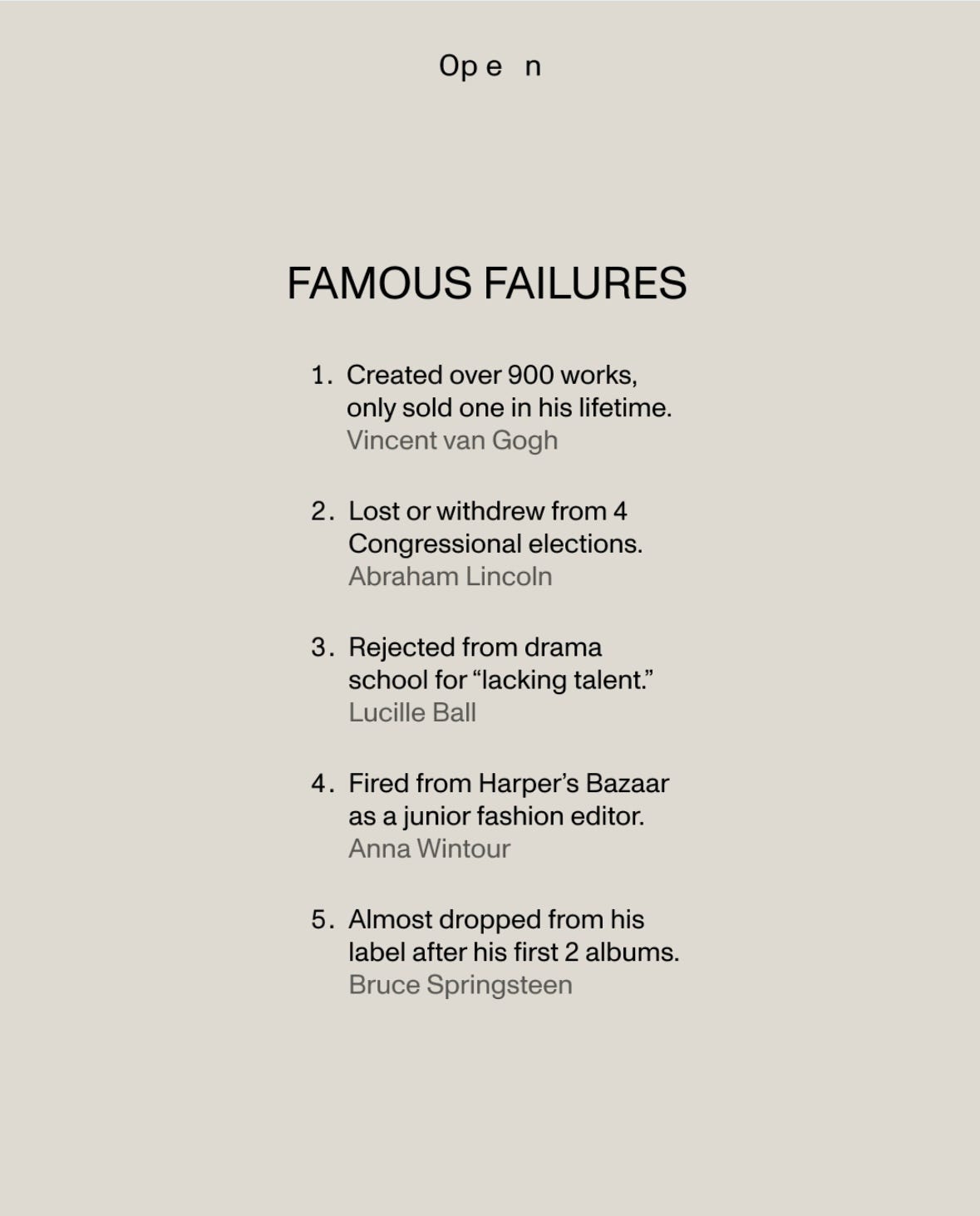
Thank you for reading. If this made you feel something, please send it to someone else who’s failed or has been told they’re too much. Or take a screenshot, share and tag me @deniselovehewett so I can love on you
.
So beautifully written, Denise!
I absolutely loved how you reframe failure: "Failure is a testament that you took a really big swing. That you left it all on the line in service of something that made your heart beat and that made you feel alive. That you loved something enough to try."
I really needed to hear this, particularly now, as I've been maneuvering through the beginning stages of new ventures, ending projects that don't align, shifting, learning, growing, all while continuing to try.