

4 Steps to Align, Pillar Three
Connect to Something Bigger than You

After my startup failed, I was forced to confront a question I had successfully avoided for years: what actually makes me happy? If this is the rest of my life would it be enough? I had built an entire identity around achieving, being busy, and when I arrived at my first failure, there was an unraveling which became the most important education of my life.
It led me to finding real alignment. Alignment is essentially inner peace. You’re living in your purpose and values, you find ease in the every day, you’re not betraying yourself to work, live, or exist. When you’re in that state, life has a way of unfolding.
The Too Much workbook is OUT TODAY! It was built around the questions I asked myself during my life crisis, the questions that led me to love my life. If you’re feeling unclear about your life’s direction, you know something needs to change but you don’t know where to start, you want more synergy between your values and your life, this workbook is for you. And if it’s not for you, may I ask you to send the link to a friend (or 5) who could use it? Or buy it to gift someone? I made it to be of service and I would love to see it get out into the world, I need your help to make that possible! The first 25 buyers will be invited to a special zoom in which we workshop the workbook together. We already have a few dates for workshops at universities, bookstores and community spaces and happy to do more! Please reach out if you have an opportunity for me to speak or host a workshop.
I have a 4 step formula to alignment I created that has helped me arrive back at this space I covet so dearly. This is part 3 in our 4 part series. Our third pillar is Connect to Something Bigger Than You
When I say connect to something bigger than you, that doesn’t have to be god or the universe. It has to be something that makes you feel small in part of the larger whole, where you can be of service, where you feel connected to a bigger picture. If we go back to the Bhagavad Gita, as shared so beautifully in The Dharma of Difficult Times by Stephen Cope, the tome describes a universal web of life held together by tiny jewels, each jewel is an individual’s soul. Every soul has a purpose to hold up their part of the net and each soul has a duty. We are here in human form to perform our sacred duties. Part of living your dharma is being of service, doing the thing that only you were put here to do to influence and support the collective. If you find your unique genius really only benefits you then you’re likely out of alignment. We’re here to bring a larger offering to humanity, and our gift, our dharma will do just that.
This takes us back to part two, when we’re focused on being of service, the outcome stops being the main point. Staying detached from that is harder than it sounds. When I was building my startup, I was essentially suffocating my dreams to death. My grasp was so tight, so intent on controlling each aspect, my therapist mused, “Denise, your dreams have no where to go, you’re holding them so tightly, the universe can’t participate.” She was right. I had to learn to be in the flow of the work, moving with the work, not creating my own resistance. Cope states that, “Grasping is another form of doubt…clinging to a particular outcome splits the mind from the present moment.”¹ We want to have attachment to our dharma, not to any particular outcome.
We’ve talked about the illusion of power in Part 2 as well. David Hawkins makes a vital distinction in his aptly named book, Power Vs. Force. He defines actual power as deriving from meaning. Pure ‘force creates counter-force…which inherently creates conflict and enforces a win-lose idealogy rather than a win-win.’ Hawkins references Ghandi, “a 90 pound person of color who single-handedly overcame the British Empire, which was then the greatest force in the world…he did it by simply standing for a principle: the intrinsic dignity of man and his right to freedom, sovereignty and self-determination. Violence is force and Ghandi was aligned with power not force which allowed him to unite the will of the people.”²
And let’s be honest, force is exhausting. The way I think of force is as the gaming and manipulation of outcome. It divides and is unsustainable. Forcing things was my understanding of survival for a very long time. The belief that we can control our career, our love life, our relationships, yada, yada, when there is so much not up to us. That doesn’t mean we sit idly by and take no action but it means we’re not expending energy chasing. Energetically and spiritually, they’re different. When we focus on joy and being of service to something greater than us, we find that life attracts to us and we don’t have to force life.
As Hawkins so beautifully states, ‘power accomplishes with ease what force, cannot.” For example, I can pitch ten people. I can be in their inbox twice a week trying to architect a sales funnel, and sometimes that works. But it’s an exhausting system. Now, instead of trying to engineer an outcome, I send the pitch or ask a friend for an introduction and release my attachment. The right pitches will connect.
When I reach out to guests for my podcast, the ones I don’t have to convince are usually the most aligned. Dr. Keltner, for example, I had pitched in 2022 and it didn’t materialize. Then last year with the political landscape, I felt his message was needed so I pitched again. He agreed and the episode was ten times better than it would have been three years ago because we were able to fuse his work on power with his work on awe to bring a more dimensional conversation about the current political landscape. My ability to relinquish attachment to the outcome alleviated the stress and allowed the process to naturally unfold versus trying to control each piece of it. I could have forced this conversation four years ago but it wouldn’t have been nearly as impactful as the one we did last year.
When we hold our dreams by their neck and try to control how they come to be, there’s no space for movement, nowhere for the dreams to go. We get in our own way of the infinite possibilities because we only see one path. My therapist says that when we derive things to meaning we limit ourselves to what is known. When we drive from our perception of the world we actually inhibit what is possible. The universe dreams far greater than we can. When I let the universe show me, I am constantly in awe of the inherent magic, it reveals routes and paths that I wasn’t even conscious of.
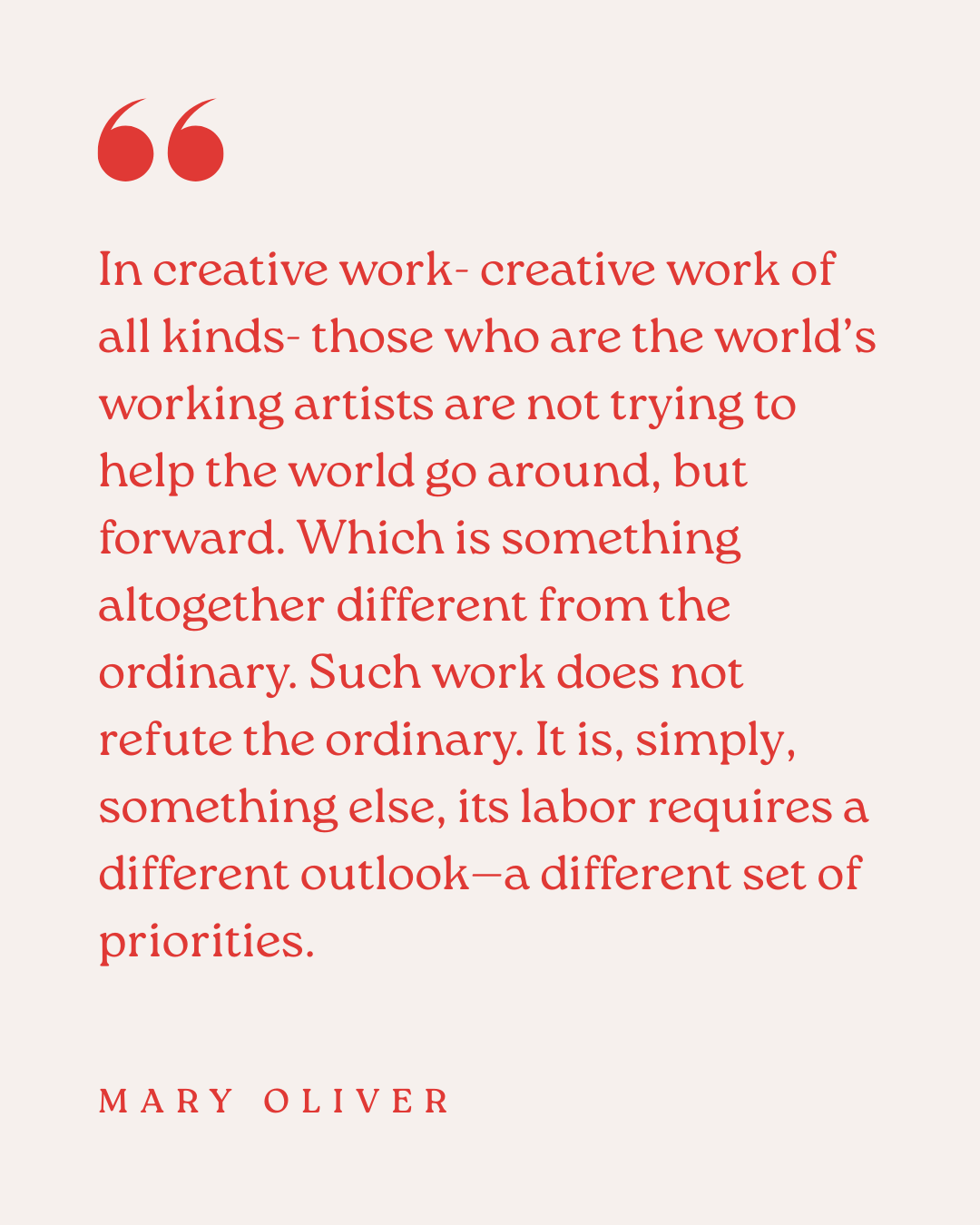
Twyla Tharp is a great example of someone living in her dharma and allowing her life to unfold accordingly. She shares that over her very long career of choreography, there were a lot of misses. She failed more than she succeeded because as she understood it, our job is to be in the making. We don’t get to decide how it’s received. My ego gets in my way all the time. I trip up over the audience size of this Substack, my podcast, etc. I have to tell myself all the time, “my only job is to be in my dharma, do work I believe is of service and that’s it” but this is a tightrope that I walk imperfectly which is why I return to these steps often.
Tharp learned this over a lifetime of making. John Keats, a poet, compressed it into a few short years. At 21, he wrote a 4,000 word narrative poem, Endymion, about the hero’s journey, the shades of life, facing failure and finding consciousness. It was not an external success but it transformed him, “it was soul-making.”¹ I relate to this deeply, I believe my startup journey was really a spiritual one. I became a different person through building it. Though, it was an external failure, it was a great internal success. Sometimes the routes we take are in service of our soul, to better ourselves, to become someone who can wield our gifts to greater service. That’s why we can’t focus on outcome, we don’t know what is intended for our soul and our dharma.
Your dharma doesn’t have to be your job. It could be your volunteer work, your painting practice, anything that truly fills your cup. In 1997, a study found that workers classify themselves in three categories in relation to work: a job, a career or a calling. A job pays the bills, it allows the person to enjoy their time away from work. A career brings more investment. People derive pleasure from advancing. Those with a calling find their work and personal life intertwined.⁴ The work is meaningful because they view it as a contribution to the greater good, leaning into their strengths and giving them purpose.⁷ The goal for everyone is different but I would argue we spend so much time working, it’d be lovely if we found it fulfilling.
If you feel stuck professionally, remind yourself that “the problem you are solving… should always be connected to something larger- a bigger question, an overarching idea, an inspiring goal. Whenever your work begins to feel stale, you must return to the larger purpose and goal that impelled you in the first place.”³ Purpose is prismatic. We can have many expressions of purpose, and often we’re stuck because we’re tied to one pathway. If we let go of our only perceived way, other routes avail themselves to us. The energy on our specificity frees up and we can be more present.
Presence is foundational for great leadership. This is why dharma-led leaders tend to operate differently. They’re more community oriented and compassionate. When you’re not leading from ego or scarcity, you’re not threatened by the success of your team. You’re not hoarding credit or manufacturing urgency to feel relevant. You’re oriented toward the mission, toward service, which naturally pulls the people around you into alignment with something larger than any one person’s agenda. This leads to employee retention and organizations that move together rather than against each other. It creates systems of harmony.
And harmony is also physiological. In Chinese philosophy, Qi connects our physical and mental states, it is both energy and function in the body, and when it flows freely, we thrive. I interviewed Sandra Lanshin Chiu, who specializes in TCM, Acupuncture and Dermatology. Her work centers around The Original Face Theory, a Chinese philosophy that holds: when we are in alignment, we look younger and more beautiful. Purpose, it turns out, is also written on the face. Science backs this up. When we are living in our purpose, there are health benefits. We reduce “the negative effects of chronic stress…When we intentionally include certain acts in our lives that bolster our sense of purpose, it increases resilience, promotes healthy behaviors and alters the brain and peripheral biology in meaningful ways.”⁵
But all of this, the dharma, the leadership, the physiology, it still begs the question: how do we actually get there?
Awe is our quickest portal. Dr. Dacher Keltner shares “In relation to awe, our individual self gives way to the boundary dissolving sense of being part of something much larger.” When we cultivate awe, “our default self vanishes…we shift from a competitive dog-eat-dog mindset to perceive that we are part of networks of more interdependent, collaborating individuals. We sense that we are part of a chapter in the history of a family, a community, a culture. An ecosystem.”¹⁰
Dr. Keltner created what he’s dubbed the awe-walk, a walk taken with the intention of attention. People slowwwww down and take in their surroundings. He studied this phenomenon and over time, people’s selfies increasingly included less of the self, subjects drifted off to the side, showing more of the outside environment—a street corner in San Francisco, the trees, the rocks around the Pacific Ocean. Awe-walkers reported feeling less daily distress and more prosocial emotions such as compassion and amusement. The more we experience awe, the more our capacity expands to keep experiencing it.
I dare you to take an awe walk. Step outside, look up at the sky, notice the trees, the texture of the leaves, the creatures around the tree. Try and see it like it’s the first time. Or go somewhere new, where it is the first time. We can find awe more easily in novel environments with deep attention attuned to our surroundings. The awe walk is a continuation of a universal human tradition of walking mediations, pilgrimages, hiking and after dinner strolls.
But awe has greater magnitude beyond our individual self. It also mitigates biases. Keltner’s research revealed that “Witnessing others’ act of courage, kindness, strength and overcoming activates different regions of the brain than those activated by physical beauty, namely cortical regions where emotions translate to ethical action. . These encounters lead to the release of oxytocin and activation of the vagus nerve. We often sense tears and goosebumps, our body’s signals that we are part of a community appreciating what unites us. When moved by the wonders of others, the soul in our bodies is awakened and acts of reverence often quickly follow.”¹⁰
Awe is our quickest way in. “Awe shifts our minds from a more reductionistic mode of seeing things in terms of separateness and independence to a view of phenomena as interrelated and dependent. For example, brief experiences of awe shift us from the illusions of the twentieth and twenty first century thinking that we are separate selves to realize that we are embedded in complex social networks of interdependence.”¹⁰ And truly what does the world need more right now, than showing up for each other. Let yourself feel a part of the whole, the jewel that you are, holding up your piece of the net. That feeling of smallness, of belonging to something vast, is part of what it feels to be in alignment. Then take that feeling back into your work. When we remember we are in service of something larger than ourselves, we can hear ourselves more easily and identify our unique contribution. And if you’re already clear on your dharma, this feeling helps you remain in alignment.
Works Cited
Cope, Stephen. The Dharma in Difficult Times. Penguin Random House, 2022.
Hawkins, Dr David R. Power vs. Force the Hidden Determinants of Human Behavior. Dr. David R. Hawkins Rich Moses, 2025.
Greene, Robert. Mastery. Penguin, 2012.
“Apa PsycNet.” American Psychological Association, American Psychological Association, psycnet.apa.org/record/1997-03161-002. Accessed 15 May 2024.
Magsamen, Susan. Your Brain on Art. Canongate, 2024.
“Qi.” Wikipedia, Wikimedia Foundation, 28 Mar. 2026, en.wikipedia.org/wiki/Qi.
Achor, Shawn. The Happiness Advantage: How a Positive Brain Fuels Success in Work and Life. Currency, 2018.
Cope, Stephen. The Great Work of Your Life: A Guide for the Journey to Your True Calling. Bantam Books Trade Paperbacks, 2015.
Trzeciak, Stephen, et al. “Leading with Compassion Has Research-Backed Benefits.” Harvard Business Review, 27 Feb. 2023, hbr.org/2023/02/leading-with-compassion-has-research-backed-benefits.
Keltner, Dacher. Awe: The New Science of Everyday Wonder and How It Can Transform Your Life. Penguin, 2023.
EXCELLENT READ!!!!